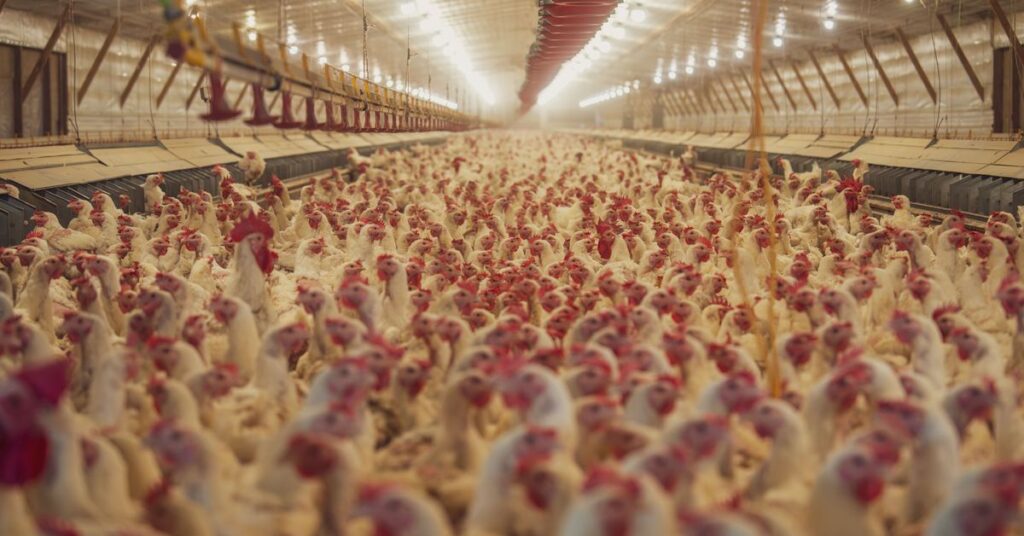
A practical poultry farming business plan starts with one question: will each batch of birds earn more than it costs once feed, chicks and loan interest are paid? Feed is about 70% of the cost of a broiler, so small changes in feed price or selling price swing profit sharply. This plan works through the numbers for a 1,000-bird and a 5,000-bird broiler unit.
It covers capital cost, per-batch profit, a price sensitivity table, loan EMI, licences and risks. Moreover, it shows where first-time farmers usually go wrong, so you can test the plan before you borrow.
Quick answer: A broiler poultry farming business plan for 1,000 birds needs roughly ₹4,80,000 including one batch of working capital. At a live price of ₹105 per kg, one batch earns about ₹21,840, and six batches a year earn about ₹1,31,040 before interest and depreciation. Profit depends mainly on the selling price, feed price and mortality.
Key Takeaways
- A broiler batch runs about 42 to 45 days, so one shed can run around six batches a year.
- Feed is the biggest cost; a feed conversion ratio (FCR) near 1.7 is a healthy target.
- Profit per kg is thin, and a ₹10 swing in live price can turn a profit into a loss.
- Plan 5% mortality in the base case, and keep a cash buffer for a bad batch.
- Poultry is an allied agriculture activity; many banks lend for it under Mudra and agri schemes.
Assumptions Behind This Poultry Farming Business Plan
All figures in this poultry farming business plan are illustrative. Prices change by state and by month, so replace each assumption with a current local quotation before you apply for a loan.
| Assumption | Value used | Notes |
|---|---|---|
| Chick price | ₹32 per chick | Check your hatchery or integrator rate |
| Feed price | ₹42 per kg | Feed is the main cost; compare suppliers |
| Feed per bird sold | 3.4 kg | About 2.0 kg bird at an FCR near 1.7 |
| Mortality | 5% | Includes culls; good farms stay at 3% to 5% |
| Other variable cost | ₹10 per chick | Vaccines, medicines, litter, power, water |
| Average sale weight | 2.0 kg per bird | At roughly 39 to 45 days |
| Live selling price | ₹105 per kg | Varies widely with season and region |
| Batches per year | 6 | Includes cleaning and rest between batches |
| Labour | Owner-managed | No paid helper in the 1,000-bird case |
Project Cost: 1,000-Bird and 5,000-Bird Broiler Units
Every poultry farming business plan should allow one square foot of shed per bird, and keep the farm away from homes and water bodies. Cost depends heavily on the shed type, so a low-cost bamboo or GI sheet shed costs far less than a brick shed.
| Cost item | 1,000 birds (₹) | 5,000 birds (₹) |
|---|---|---|
| Shed (1 sq ft per bird) | 2,00,000 | 7,00,000 |
| Equipment: feeders, drinkers, brooders | 40,000 | 1,50,000 |
| Feed store, water tank, electrical work | 50,000 | 1,00,000 |
| Pre-operative expenses and licences | 10,000 | 20,000 |
| Working capital for one batch | 1,80,000 | 8,90,000 |
| Total project cost | 4,80,000 | 18,60,000 |
Published estimates vary a lot. For example, many online guides put a 5,000-bird unit between ₹12 lakh and ₹18 lakh, because land, shed type and supplier credit differ. Hence, get your own shed and equipment quotations.
Land is extraThese figures exclude land. Own or leased land with water and power access is a must, and many states need a panchayat or municipal NOC before construction.
Cost and Profit per Batch
Now look at the profit logic of the poultry farming business plan for one batch. The table starts with 1,000 chicks and applies the assumptions above. Birds sold equal chicks placed minus mortality.
| Item | 1,000 birds (₹) | 5,000 birds (₹) |
|---|---|---|
| Chicks placed | 1,000 | 5,000 |
| Birds sold (after 5% mortality) | 950 | 4,750 |
| Chick cost | 32,000 | 1,60,000 |
| Feed cost | 1,35,660 | 6,78,300 |
| Vaccines, medicine, litter, power | 10,000 | 50,000 |
| Total cost per batch | 1,77,660 | 8,88,300 |
| Revenue at ₹105 per kg live weight | 1,99,500 | 9,97,500 |
| Profit per batch (before interest and depreciation) | 21,840 | 1,09,200 |
| Cost per kg sold | ₹93.5 | ₹93.5 |
At these assumptions, the cost of producing one kilogram is about ₹94. So the margin is only about ₹11 per kg. That is why scale and discipline matter.
Price Sensitivity: What If the Live Price Falls?
In any poultry farming business plan, price is the biggest unknown. Broiler prices swing with festivals, heat waves and disease news. Therefore, test the plan at several prices before you commit.
| Live price per kg | Profit per batch, 1,000 birds (₹) | Profit per year, 6 batches (₹) |
|---|---|---|
| ₹90 | -6,660 | -39,960 |
| ₹100 | 12,340 | 74,040 |
| ₹105 | 21,840 | 1,31,040 |
| ₹110 | 31,340 | 1,88,040 |
| ₹120 | 50,340 | 3,02,040 |
The table shows the risk clearly. Below roughly ₹94 per kg, this unit loses money on every batch. Consequently, a lender will ask how you plan to survive a weak market, for example through a cash buffer or a contract with an integrator.
Contract farming as a risk reducer
Under a contract model, an integrator supplies chicks, feed and medicines, and the farmer provides the shed and labour. The farmer earns a growing charge per kg, often with a bonus for good FCR. Profit is lower in good times but steadier in bad ones. Compare the terms carefully, and read the agreement before you sign.
Loan, EMI and Repayment for the 1,000-Bird Unit
Suppose you bring ₹80,000 yourself and borrow ₹4,00,000 at 11% for five years. The EMI is about ₹8,697 a month, or ₹1,04,364 a year.
| Item | Amount (₹ per year) |
|---|---|
| Operating profit (6 batches at ₹105 per kg) | 1,31,040 |
| Add back depreciation (approx.) | 25,000 |
| Add back interest (average over the loan term, approx.) | 26,400 |
| Cash available for loan repayment | 1,82,440 |
| Annual loan repayment (EMI × 12) | 1,04,364 |
| Approximate DSCR | 1.75 |
At ₹105 per kg, the DSCR clears the usual minimum of 1.25. However, at ₹100 per kg it falls to about 1.20, which is below the bank’s comfort level. Run your own figures through the DSCR calculator and the working capital loan calculator before you apply.
Poultry qualifies as an allied agriculture activity under Mudra, so a Mudra loan can fund a small unit. Larger units may need a CGTMSE-backed bank loan; see the CGTMSE scheme guide. Subsidies exist under some state and national livestock schemes, but conditions vary, so ask your local animal husbandry office.
Licences and Registrations for a Poultry Farming Business Plan
| Registration | Why you need it |
|---|---|
| Udyam (MSME) registration | Free; needed for most loans and schemes |
| Panchayat or municipal NOC | Permission to build and run the farm |
| Pollution control board consent | Required in many states above a bird-count threshold |
| Veterinary or animal husbandry registration | Required by some states for farms |
| FSSAI | Needed if you process or sell dressed chicken |
| GST | Needed if turnover crosses the limit or you trade in taxable items |
Start with Udyam; our MSME registration online guide covers it. The wider launch sequence is in how to start a business in India.
Shed, Biosecurity and Health in a Poultry Farming Business Plan
- Location: a quiet site with good drainage, away from other poultry farms and homes.
- Shed design: a long axis running east-west, good ventilation and a raised, dry floor.
- Litter and brooding: clean litter, correct temperature and enough feeders from day one.
- Vaccination: follow a schedule from your veterinarian for diseases such as Ranikhet and Gumboro.
- Biosecurity: restrict visitors, use foot dips and keep wild birds out.
- All-in, all-out: empty, clean and rest the shed between batches.
Risks in a Poultry Farming Business Plan
A lender reads the risk section of a poultry farming business plan closely. Show that you know each risk and have a plan for it.
| Risk | Effect | How to reduce it |
|---|---|---|
| Price crash | Profit turns negative | Cash buffer, forward sale or contract farming |
| Disease outbreak | High mortality, whole batch lost | Vaccination, biosecurity, vet support |
| Feed price spike | Cost per kg rises | Buy in bulk, compare suppliers, track FCR |
| Heat stress | Slow growth and deaths | Ventilation, fans or foggers, water supply |
| Power cuts | Brooding and ventilation fail | Backup generator or solar |
| Weak buyers | Delayed payment | Work with known traders; avoid long credit |
How to Present This Plan to a Bank
Bankers want the full picture from your poultry farming business plan: cost, finance, profit, cash flow and DSCR for the loan tenure. Our project report format guide lists each section, and the project report for bank loan guide shows what they check. Build the tables quickly in the free project report maker.
If you are new to farming loans, read our startup loan for new business guide too. Strong promoters usually have some poultry experience or training, so mention any you have.
FAQs on Poultry Farming Business Plans
How much investment does a poultry farming business plan need for 1,000 birds?
A basic unit with a low-cost shed needs roughly ₹4,80,000 including one batch of working capital, excluding land. Costs vary with the shed type and local rates.
How much profit does a broiler farm make per batch?
Under the illustrative assumptions here, a 1,000-bird batch earns about ₹21,840 at ₹105 per kg live price. Profit can turn negative if prices fall below the cost per kg.
How many batches can I run in a year?
Most farms run about six batches a year. Each batch takes 42 to 45 days, and you need a few days to clean and rest the shed.
What is a good FCR for broilers?
An FCR of about 1.6 to 1.8 is usual for well-managed farms. A lower figure means less feed per kilogram of weight gain and higher profit.
Can I get a loan for a poultry farm?
Yes. Banks lend for poultry under Mudra and agriculture-allied schemes. They will ask for a project report, KYC, land papers or a lease and the required NOCs.
Which licences does a poultry farm need?
Typically Udyam registration, a panchayat or municipal NOC and pollution consent where applicable. You need FSSAI only if you process or sell dressed chicken.
Is contract farming better than independent farming?
Contract farming gives steadier but lower income and reduces price and feed risk. Independent farming can earn more in good months but loses more in bad ones.
What are the biggest risks in broiler farming?
Price swings, disease outbreaks, feed cost increases and heat stress are the main risks. Biosecurity, vaccination and a cash buffer reduce them.
Final Word on the Poultry Farming Business Plan
A good poultry farming business plan treats price and disease as real risks and shows the bank that the loan can still be repaid in a weak month. Replace every assumption here with local quotes, test the sensitivity table and start with a size you can manage.
Put your own numbers into the project report maker, explore the free business tools, read more project report guides and visit the Business Reports homepage.
Business Reports is an independent information website. We are not affiliated with, endorsed by or acting for any government department, bank, NBFC, KVIC, NABARD, SIDBI or MUDRA, and we do not provide loans or process applications. Figures are indicative; confirm details on official portals or with your bank. Read our disclaimer and advertising disclosure.